What Learners Really Experience: Reflections from the LiftOff Design Sprint
I recently had the opportunity to participate in the LiftOff Design Sprint, where 75 leaders from education, technology, research, philanthropy, and civic sectors came together in Silicon Valley. Over three days, we worked in teams to rapidly prototype 10 innovative learning models designed to help young people build the habits, skills, and mindsets they need to thrive in the age of AI. Most importantly, young people were engaged as full design partners, shaping the work alongside us rather than simply taking part.
Before our teams ever sat down to tackle the design work, we were asked to do something different: step into the shoes of young people. Not in the metaphorical sense, but to actually step in.
Five immersive experiences that were designed entirely by youth consultants (ages 16-22) were set up around the space. Their goal wasn’t to inform us. It was to immerse us. To let us feel, even briefly, what it is like to navigate today’s world as a young person.
I’ve spent my career listening to students through panels, empathy interviews, and classroom visits, and I’ve even shadowed students for a full school day. But what these young people created was something else entirely. It was precise, artful, and emotionally disarming. And it powerfully shaped how the LiftOff Design Teams tackled our essential question:
“How might we create Horizon 3, future-ready, comprehensive learning models that inspire and prepare young people to flourish in life, career, and democracy in the age of AI—serving both individual potential and the common good?.
The five immersive experiences were intentionally set up across different rooms and areas of our shared workspace, creating distinct environments that adult teams rotated through together as part of the design process. Below are reflections from each immersive zone, including what happened, what I felt, and what I now can’t unsee.
Zone 1: The World of Inputs
“Design for now, not then.”
This zone forced me to confront how quickly the world has shifted—and how often adults fail to update our mental model of what it feels like to grow up today. The space was lined with posters mapping major cultural and technological moments across decades, alongside artifacts like CDs and other objects that marked the pace of change. I realized how nostalgic I still am for my own 90s childhood. Fewer inputs. Slower pace. Less comparison.
The youth reminded us that our adolescent experiences are not their world. Their baseline is noise, overload, and constant comparison, which is a pace that adults simply did not grow up with.
They challenged us to examine where we are designing learning for the childhood we remember, instead of the one they are actually living. Their provocation card asked:
“What changed the most between your childhood and ours – and between our childhood and adolescence?”
It set the tone for the entire design sprint: before we solve anything, we must first see with clarity the waters in which today’s youth are swimming.
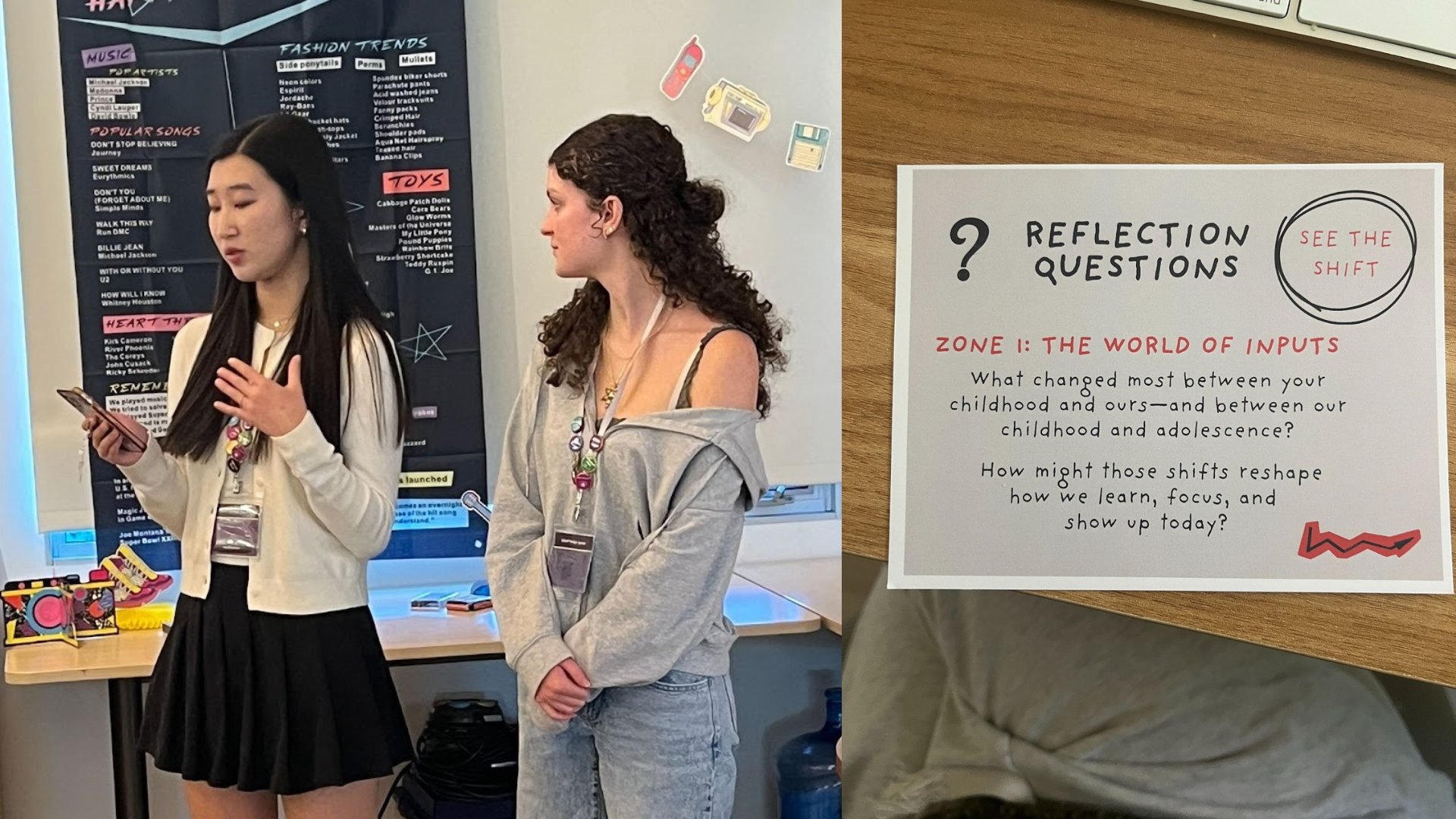
Left: Learners presenting the Zone 1 design experience. | Right: Zone 1 reflection questions
Zone 2: The Weight We Carry
“Design for the burdens you can’t see.”
I couldn’t stop thinking about this zone afterward.
My colleague volunteered to put on a backpack and, as she climbed stairs, began picking up heaving reams of paper and reading aloud the quiet burdens students had written on sticky notes:
“I am alone.”
“My mom is an addict.”
“I feel so stupid.”
With each note, she picked up another heavy object to place in her bag. The physicality of it mattered. I watched as the emotional weight became literal. She cried as she read the notes aloud as she ascended the stairs. We cried watching her.
Then, at the top of the stairs, she was told she had gotten her period. Cramp simulators were placed on her abdomen. And then, because life doesn’t pause, she was gruffly told to go back to class.
The design implication card captured it perfectly:
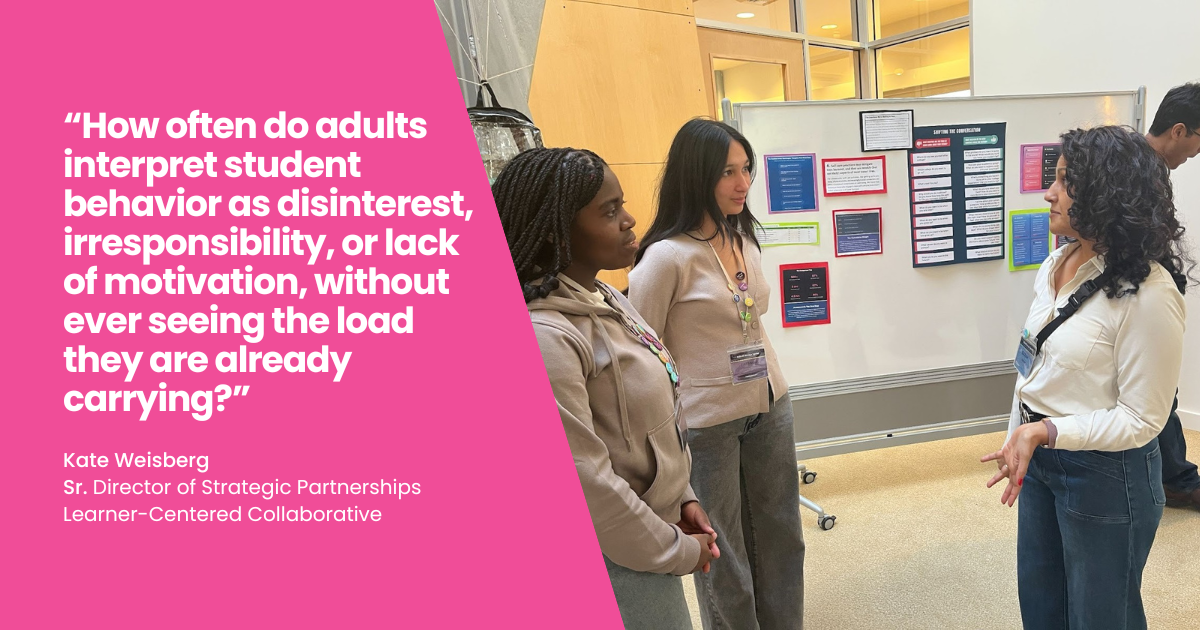
“Young people carry stress, pressure, and stories that rarely reach the surface… Build systems that don’t rely on perfect conditions.”
It reminded me how often adults interpret student behavior as disinterest, irresponsibility, or lack of motivation, without ever seeing the load they are already carrying.
Read More: If No One Was Telling Us What To Do, What Would We Build?
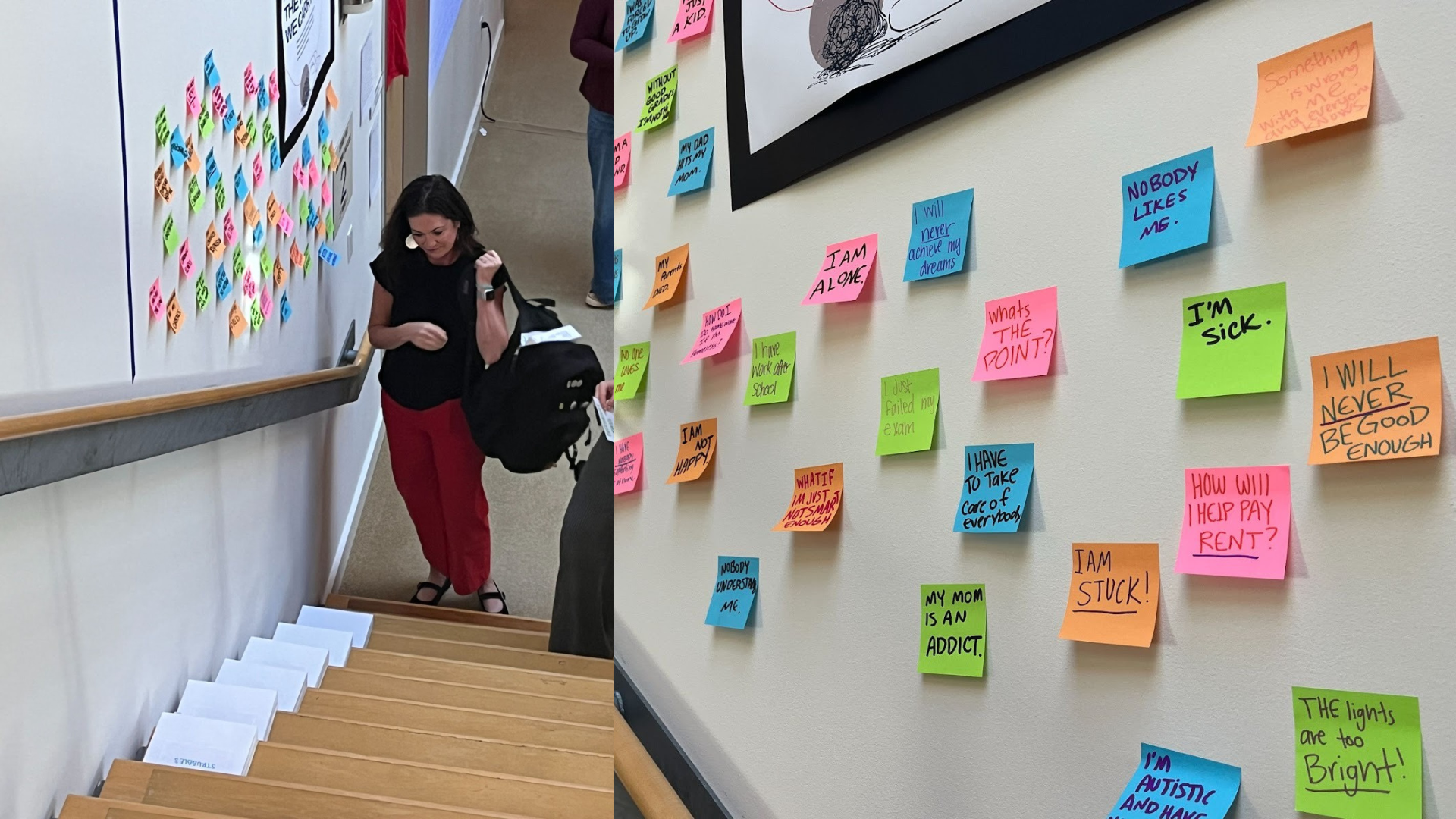
Left: LiftOff participant carrying the metaphorical loads learners carry each day | Right: Examples of the challenges learners carry that aren’t always visible
Zone 3: The Selves We Switch
“Identity-switching takes real energy.”
In this zone, we started by looking at ourselves in different mirrors that represented different audiences: family, close friends, teachers, and social media. I then watched a colleague simulate conversations with these different groups, played by the youth consultants. The shifts my colleague made were instant and painful to witness. Self-protective with one person. Polite with another. Overly confident with a third.
The youth who designed this zone wanted adults to feel how often young people negotiate which version of themselves is safest in each space. Their card asked:
“What patterns of adaptation stand out, and what does that tell you about the pressure they face?”
It hit me that every time a young person has to switch selves (especially at school), we are taxing their cognitive and emotional bandwidth before learning even begins.
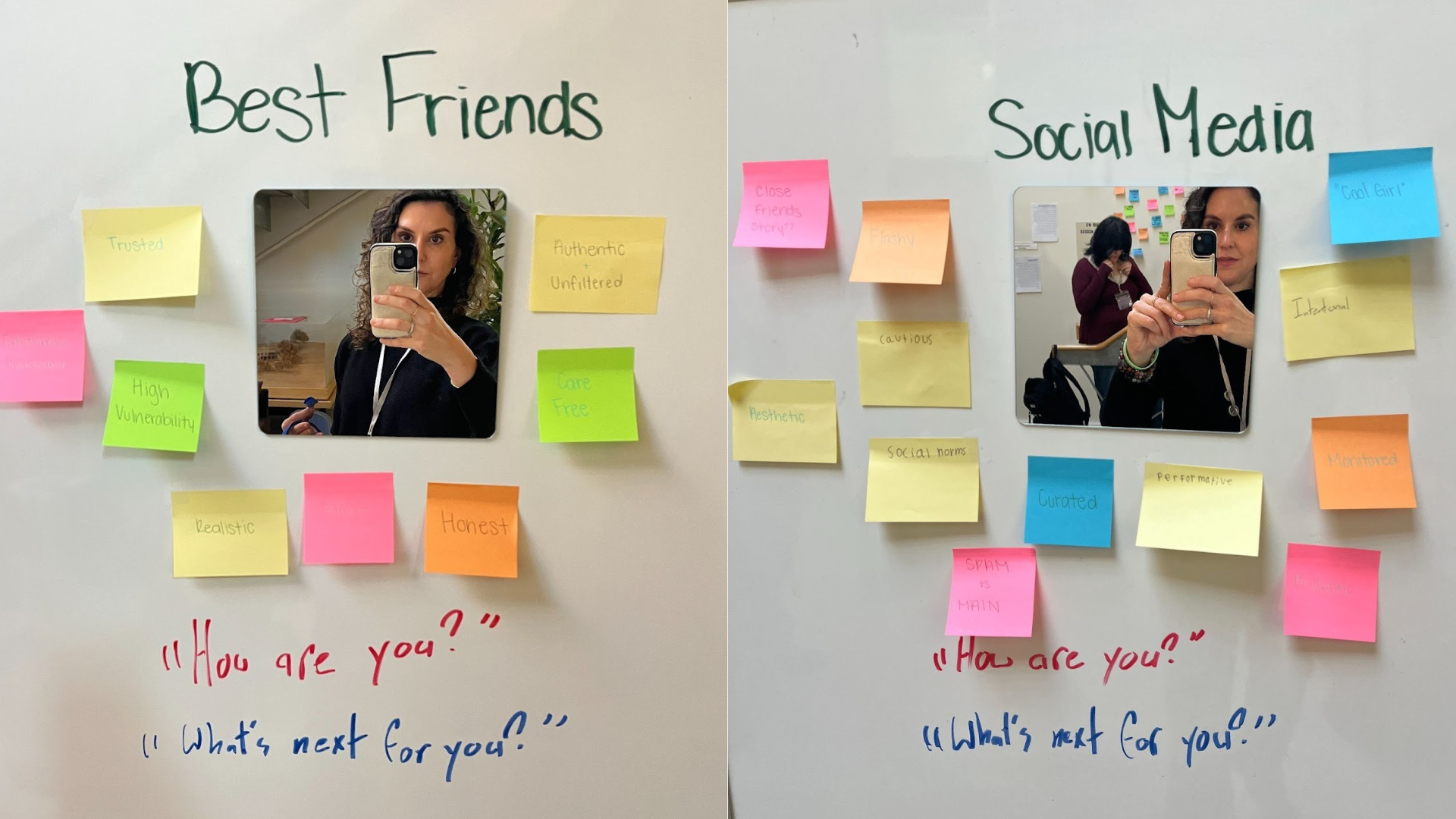
The literal mirrors we were invited to look at and reflect how/who we are in front of each audience.
Zone 4: The Rules That Contradict
“Expose the impossible ask.”
This zone was brilliantly maddening. I was handed a vague card and a pipe cleaner. My instructions were to “create the most polished pipe cleaner figure possible, with clean lines, symmetry, and smooth bends.”
But here was the twist: Every mistake would cost me a point. A mistake was defined as… basically anything. The clock was ticking.
I felt confused, stressed, and irritated. Was I doing this right? How would I know? Who set these expectations?
When I hit the buzzer to ask for help, I was publicly critiqued:
“Those lines don’t look very smooth to me!”
Later, the young person who designed the experience explained to me that, beyond wanting me to experience what it’s like to try to follow unclear instructions, they wanted me to feel the humiliation of a teacher addressing me in front of the class. “It may not seem like a big deal to you, as a teacher, to say something out loud about my work, but for me, it can be so humiliating.”
The question they posed in this immersive experience was:
“Where do rules or expectations feel impossible to meet—and what hidden challenges does that reveal for youth?”
Adults often mistake students’ frustration for defiance. This zone showed me it’s often exhaustion from managing contradictory or unattainable demands.
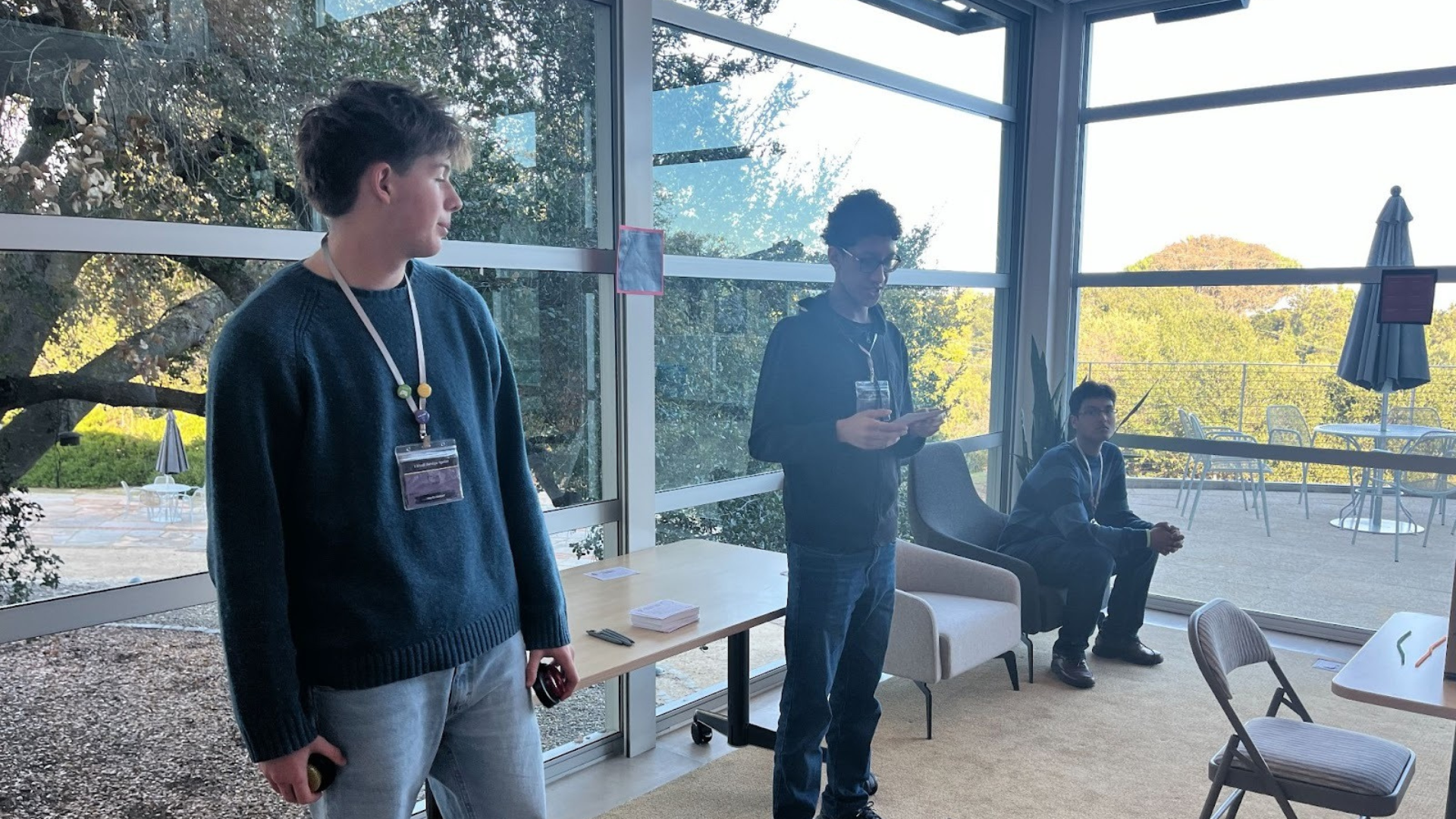
Learners explaining their pipe cleaner activity
Zone 5: The Paths That Trap
“A path that can’t be undone isn’t a learning path—it’s a trap.”
Our final stop was a board game (of sorts) that mirrored the path to college and career.
Some of us got an early advantage because our parents had college degrees. Some missed a scholarship deadline and had to go back two spaces. Some hit unexpected financial barriers. Some got derailed when the FAFSA website “crashed.”
The randomness wasn’t random: it was designed. And every setback was structural, not personal.
The youth asked us to consider:
“Where do structures limit options, and how might they shape the choices youth feel able to make?”
This zone left me thinking about how often we attribute success to individual effort when the real story is access, timing, luck, or systemic design.
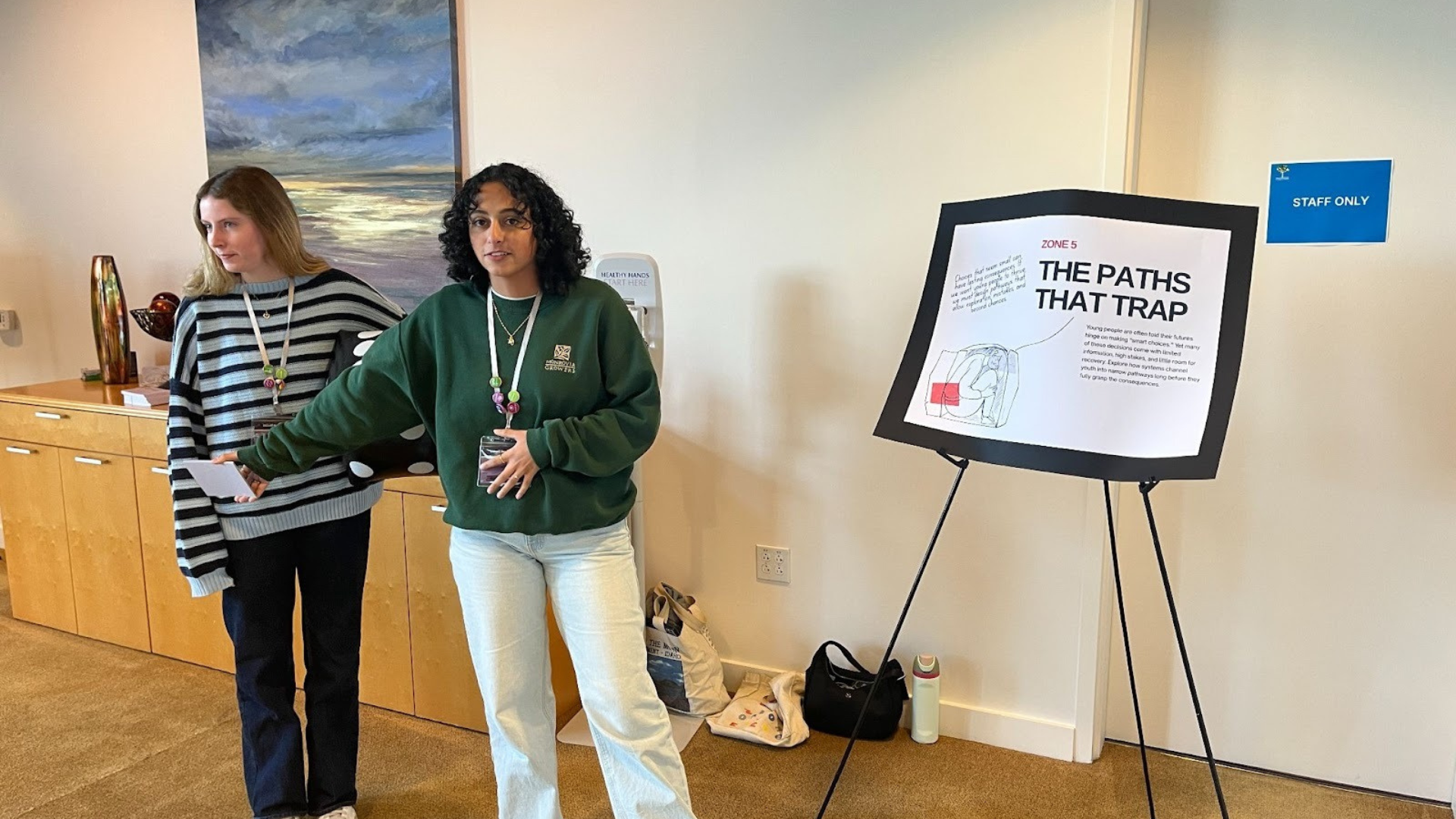
Learners presenting the Zone 5 design experience
Why These Experiences Mattered
At LiftOff, our charge was to imagine schools that support young people to flourish in the age of AI. But the youth insisted we start with a more fundamental step: See us. Understand us. Feel what we feel.
Their immersive experiences did what no panel or empathy interview could. They cracked open our adult certainty. They slowed us down. They made space for our discomfort, our awe, and in some cases, our tears.
What I’m Taking Forward
Here’s what I’m carrying with me as we continue our design work:
- When young people tell us the world feels overwhelming, believe them.
- When they seem disengaged, look for the invisible weights.
- When they switch selves, understand the pressures shaping those choices.
- When they push back, examine the contradictions they’ve been asked to manage.
- When they struggle to advance, interrogate the systems—not the student.
Most of all: Design with them, not for them. Because when youth lead, they don’t just give us insights, but entirely new ways to see.
Designing “with” not “for” is core to our work with school and district partners throughout the United States. “With” includes families, learners, educators, and administrators because that’s what’s required if we want to design the future of public education. Ready to learn how this might apply in your learning community? Contact our team here.